Mechanical and Thermal Characterization
My background in Materials has provided extensive experience with a wide range of mechanical and thermal characterization techniques. Through my research activities, I have gained hands-on experience conducting tensile, shear, flexural, short-beam shear, and fracture tests to evaluate material behavior and structural performance. The images below highlight experimental work from research projects in which I have been involved. These testing configurations demonstrate the use of strain gauges, extensometers, load cells, and Digital Image Correlation (DIC) systems to measure load, displacement, deflection, and strain, enabling detailed assessment of mechanical response, deformation mechanisms, and damage evolution.
Tensile Testing Shear Testing Flexural Testing Sandwich Beam Facing Debond Testing Mode I and Mixed Mode Fracture Testing DSC TGA DMAAxial Tensile and Transverse Tensile Testing
Axial and transverse tensile tests characterize how a composite responds to loading along and across its reinforcement direction. Extensometers provide local strain measurements, while DIC tracks full-field surface deformation and helps identify where strain concentrates.
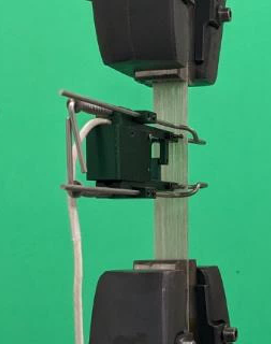
A composite tensile specimen held in the testing-machine grips with an extensometer attached to measure strain.
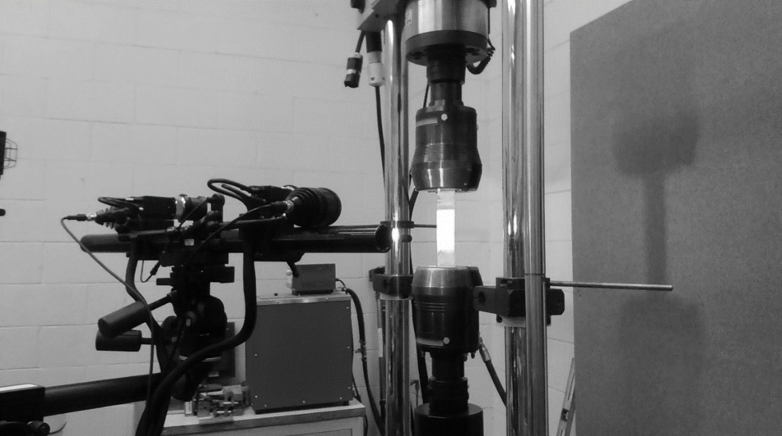
A tensile specimen in a load frame with cameras positioned to record its surface strain for digital image correlation analysis.
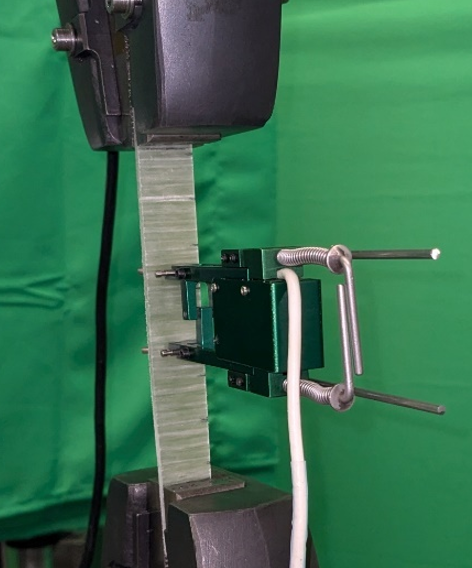
A transverse tensile specimen gripped in the test frame with an extensometer measuring local strain.
In-Plane Shear Testing
In-plane shear testing evaluates deformation and response under shear loading. A bonded strain gauge measures local strain on the specimen during the test.
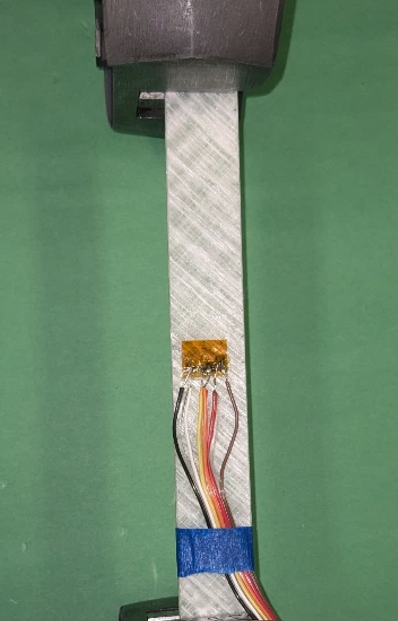
A composite in-plane shear specimen with a bonded strain gauge and lead wires for measuring local deformation.
Flexural and Cantilever Testing
Flexural tests assess bending response and stiffness. Four-point bending creates a region of nearly constant bending moment between the loading noses; DIC can capture deformation across that region. Cantilever loading provides another way to study deflection and structural response under bending.
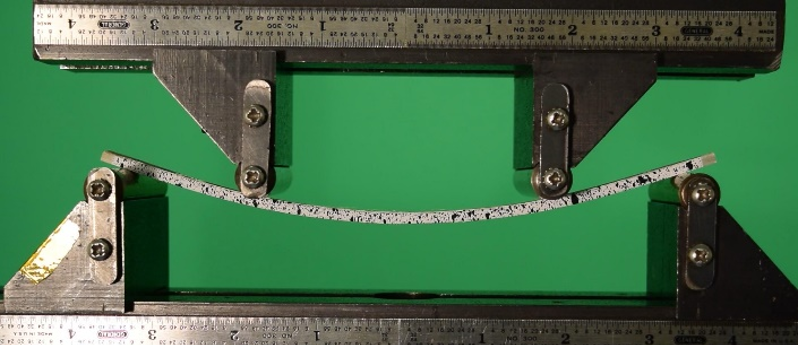
A composite beam deflecting in a four-point bending fixture, with its surface prepared for DIC measurements.
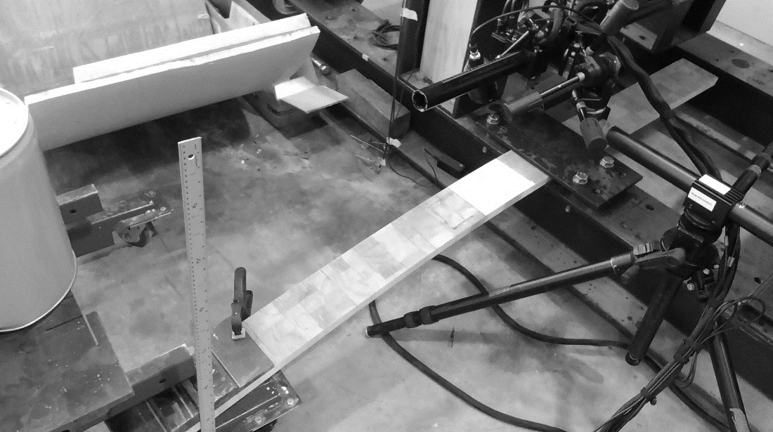
A cantilever beam that had its skin repaired being tested with a digital image correlation equipment positioned to record deformation during loading.
Sandwich-Beam Facing Debond Test (SCB)
SCB tests examine the interlaminar fracture toughess between a face sheet and core under Mode I loading. The single-cantilever-beam (SCB) setup allows the face-sheet/core interface to be assessed as the beam deflects.
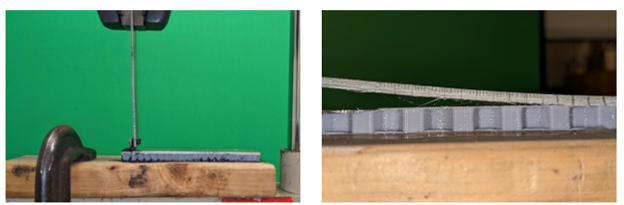
Two views of a sandwich-beam test: loading applied to the specimen and a side view of the face sheet above the core.
Mode I and Mixed-Mode Fracture Testing
Fracture tests characterize resistance to crack growth in composite laminates and bonded interfaces. Mode I testing opens a crack, while mixed-mode testing combines opening and shear to evaluate response under a more complex loading state.
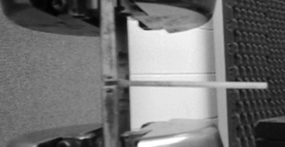
A composite specimen in a Mode I opening test, used to observe crack growth under tensile separation.